
A filler may be perfectly suited to the treatment plan, but the wrong cannula can make placement harder than it needs to be.
A cannula that is too flexible may feel difficult to direct. One that is too short may require extra entry points. A narrow lumen may create unwanted resistance when injecting a thicker product.
The solution starts with understanding what each cannula specification actually changes.
Gauge, length, wall thickness, tip shape, surface finish, and hub construction all affect how a cannula moves through tissue and how the filler flows through the shaft. This cannula needle guide explains those differences so trained aesthetic professionals can choose a device based on anatomy, treatment goals, injectable product, and clinical technique.
What You’ll Learn in This Article
This guide explains how to:
- Read cannula gauge sizes correctly
- Choose a suitable cannula length
- Compare blunt cannulas with sharp needles
- Understand wall thickness, tip shape, shaft flexibility, and hub design
- Match cannula specifications to different treatment areas
- Consider filler thickness, tissue plane, and injection technique
- Review safety, sterile handling, and single-use requirements
- Understand the manufacturing and quality features of ELASTY Micro Cannulas
What Is a Cannula Needle?

A cannula is a hollow tube used to introduce or remove fluid from the body. The term covers many medical devices, including an IV cannula, nasal cannula, drainage cannula, and aesthetic microcannula. In general medical use, cannulas may deliver medication, fluids, or oxygen, draw blood, or drain fluid.
Main Parts of an Aesthetic Cannula
A typical blunt cannula includes:
- A hollow stainless steel shaft
- A rounded or blunt tip
- A side opening near the tip
- A medical hub
- A Luer lock connection
- An internal lumen that carries the injectable product
Unlike a sharp needle, the opening is usually positioned on the side of the shaft rather than at the very end.
The blunt tip does not easily pierce the skin on its own. A matching piercing needle is normally used to create the initial puncture. The cannula is then inserted through that entry point.
Aesthetic Cannula Versus IV Cannula
An aesthetic cannula should not be confused with an IV catheter.
An IV cannula commonly includes flexible plastic tubing that remains inside a vein after the sharp needle is removed. It may be used to administer drugs, deliver fluid, draw blood, or provide intravenous access.
An aesthetic microcannula is generally a hollow metal device that moves through a selected soft tissue plane during injection. It is not left inside the body after the cosmetic procedure.
Blunt Cannula Versus Sharp Needle
Both devices can place filler, but they interact with the skin and underlying tissue differently.
A sharp needle creates a direct puncture. This can provide precise placement in a small area, but each insertion cuts through tissue along the needle path.
A blunt cannula enters through a puncture made by a sharp introducer needle. Once inserted, its rounded tip may push past some tissue structures rather than piercing each one directly.
The choice should not be reduced to which device is “better.” Each has a different clinical role.
How a Blunt Tip Changes Tissue Passage
A blunt tip may support controlled movement through a subdermal plane while reducing the number of skin punctures needed for treatment.
From one entry point, an injector may use linear threading or a fanning technique to distribute product across a larger area. This can be helpful when treating broader facial contours.
A blunt tip may also reduce some tissue trauma, bleeding, swelling, or bruising compared with repeated sharp needle punctures. Still, a blunt cannula can enter, compress, or damage a blood vessel. It does not prevent vascular complications.
A 2025 review of cannula and needle use in dermal filler injection found that device selection has direct implications for safety, clinical results, and patient experience. It also supports choosing the instrument according to the treatment area and procedure rather than treating either tool as universally safer.
When a Sharp Needle May Be Chosen
A sharp needle may be considered when the procedure requires:
- A very small injection point
- Precise bolus placement
- Superficial product placement
- Direct access to a defined anatomical point
- A technique specified by the filler manufacturer
A cannula may be considered when the treatment requires broader product distribution, fewer access points, or passage across a longer tissue path.
Some aesthetic procedures use both devices during the same appointment.
How Cannula Gauge Works
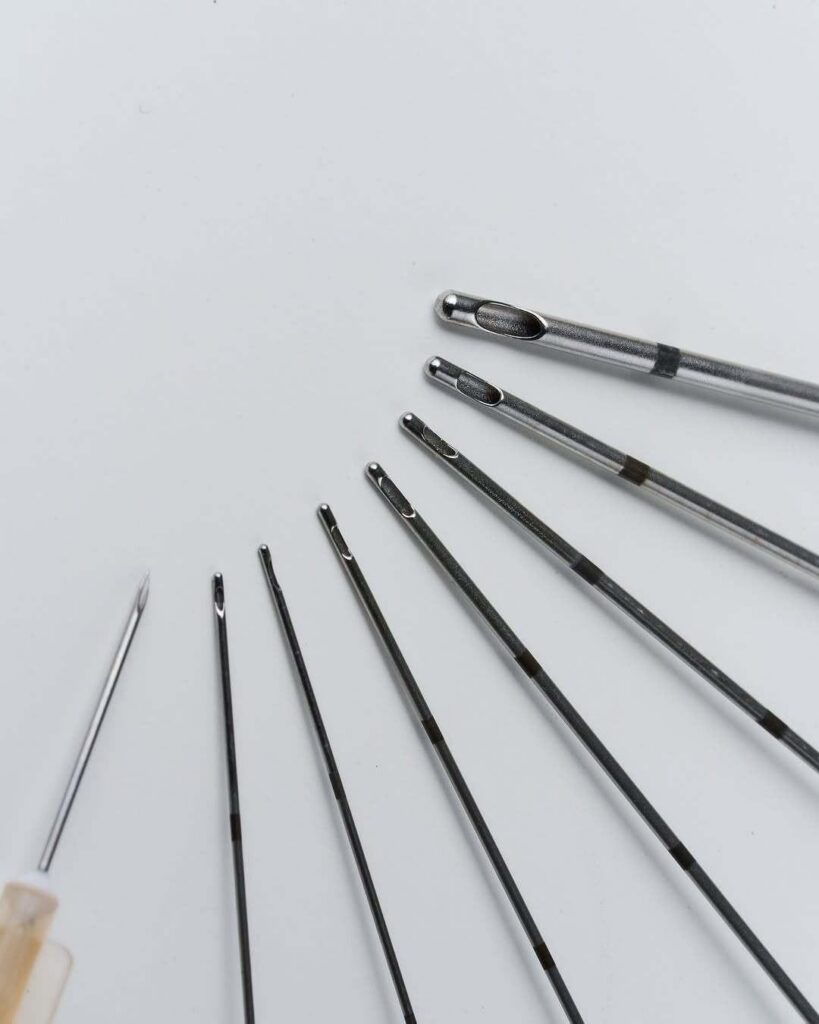
Gauge describes the external diameter of a needle or cannula.
The gauge system works in reverse. A larger gauge number means a smaller external diameter. A 30G cannula is thinner than a 22G cannula.
This same general gauge relationship is used across many medical needle and IV cannula products. Different gauges also produce different flow characteristics.
Gauge is important, but it does not tell the full story. Two cannulas with the same listed gauge may have different internal diameters because of differences in wall thickness.
How Gauge Affects Filler Flow
A lower gauge cannula usually has a larger outer diameter and may have a larger internal lumen. This can help thicker filler move through the shaft with less resistance.
A higher gauge cannula has a smaller diameter. It may create a smaller entry point, but its narrower lumen can increase resistance during injection.
Gauge can also affect:
- Shaft stiffness
- Directional control
- Flexibility
- Product flow
- Required injection pressure
- Entry point size
- Tissue feedback during insertion
The thickest available cannula is not automatically the right choice for a high viscosity filler. The product instructions, treatment plane, injector technique, and approved device compatibility must still guide selection.
ELASTY Cannula Gauge and Length Options
ELASTY Micro Cannulas are offered in several gauge and length combinations for different aesthetic procedures.
The exact available length depends on the selected gauge.
| Cannula Gauge | Relative Diameter | General Handling Consideration | ELASTY Length Range |
|---|---|---|---|
| 22G | Larger | Supports stronger flow and greater shaft presence | Up to 70 mm, based on product option |
| 23G | Moderately large | Balances flow, reach, and control | Based on available product option |
| 25G | Medium | Offers a practical balance of flexibility and flow | Based on available product option |
| 27G | Fine | Supports delicate handling and a smaller entry point | Based on available product option |
| 30G | Very fine | Intended for carefully selected applications | From 25 mm, based on product option |
ELASTY cannulas are available in 22G, 23G, 25G, 27G, and 30G, with lengths ranging from 25 mm to 70 mm depending on gauge.
Providers should confirm the exact gauge and length pairing before ordering. Select a size based on the filler, anatomical area, insertion point, intended injection plane, and preferred technique.
How to Choose Cannula Length
Length controls how far the cannula can travel from the entry point.
A longer cannula may cover a broader treatment area with fewer punctures. A shorter cannula may offer more direct control when working within a compact zone.
Neither option is always more precise. The best length depends on what the injector needs to reach and how much control can be maintained along the full shaft.
Short Cannulas for Localized Treatment
A shorter cannula may suit a small anatomical area where long reach is not required.
Potential considerations include:
- Shorter travel through tissue
- Direct hand control
- Smaller treatment zones
- Limited fanning distance
- Easier awareness of the approximate tip location
A short cannula may still require several entry points if the planned treatment covers a wide area.
Long Cannulas for Broader Coverage
A longer cannula can reach across a larger zone from one access point.
This may be useful for:
- Cheek contouring
- Lower face treatment
- Jawline placement
- Long linear threads
- Wider fanning patterns
Longer reach also requires strong anatomical awareness. The injector must understand the full path of the shaft, not only the location where it entered the skin.
The cannula tip may be several centimeters away from the injector’s fingers. Poor control at that distance can affect placement accuracy.
Cannula Design Features That Affect Performance
Gauge and length are only two parts of the selection process.
Wall construction, tip design, surface quality, shaft behavior, and hub connection can also change how the product performs during treatment.
Ultra Thin Wall Construction
Wall thickness affects the relationship between the outer diameter and the internal lumen.
An ultra-thin wall can create more internal space without requiring the same increase in external size. This may allow a viscous filler or liquid to pass through the shaft with less resistance.
ELASTY cannulas use an ultra-thin wall design intended to support stable product flow while keeping the external diameter controlled.
This does not mean every filler can be injected through every ELASTY size. Providers should always follow the instructions supplied with the injectable product.
Blunt Tip and Side Port
The rounded tip is intended to support controlled passage through soft tissue.
The filler is released through a side port near the tip. Since the product exits laterally, the injector must remain aware of the port direction during placement.
Tip shape and port position may affect:
- Tissue feedback
- Directional control
- Product release
- Placement accuracy
- Movement through the selected plane
A blunt tip may reduce some direct piercing, but it should never be treated as protection against vascular entry.
Shaft Flexibility
A flexible shaft can move through tissue with less rigid resistance. Too much flexibility, however, can make directional control harder.
A stiffer shaft may be easier to direct but could create more tissue resistance.
The right balance depends on:
- Gauge
- Length
- Stainless steel properties
- Wall construction
- Treatment area
- Injector preference
ELASTY cannulas are manufactured from medical-grade STS 304 stainless steel. This material provides a consistent shaft structure while supporting the flexibility required for aesthetic injection.
Micro Polished Surface
Surface quality affects how the cannula moves through tissue.
A rough shaft may create more drag. A smooth, micro-polished surface is designed to support softer insertion and more controlled movement.
ELASTY cannulas use micro-polishing technology to reduce surface resistance during placement. This may help reduce unnecessary tissue disruption and improve tactile feedback.
Secure Luer Lock Hub
The hub connects the cannula to compatible syringes.
A secure Luer lock helps prevent unwanted movement or separation between the syringe and cannula during the injection procedure.
The connection should remain stable while the injector advances, turns, withdraws, or repositions the shaft.
ELASTY cannulas are designed for Luer lock compatibility with standard syringes and compatible injection systems.
Clinical Uses for Blunt Cannulas

Blunt cannulas may be used for intradermal or subdermal placement of compatible soft tissue fillers.
The final device choice should be based on the patient’s anatomy, the filler, the injection plane, and the provider’s training.
Lips and Perioral Areas
The lips and surrounding tissue require controlled product placement because the area is mobile, compact, and highly vascular.
A cannula may be considered for selected lip, marionette line, or perioral techniques. A sharp needle may still be preferred for detailed shaping or exact product placement.
The decision depends on the injector’s approach and the filler instructions.
Nasolabial Folds and Cheeks
These areas may require product placement across a broader section of tissue.
A longer cannula may support fanning or linear threading from a limited number of entry points. Gauge should be matched to the filler’s viscosity and the required injection depth.
Cheek treatment may involve more than one tissue plane, so no single cannula size fits every
Jawline and Lower Face
The jawline often involves longer treatment paths and structural contouring.
A cannula with suitable reach may help place filler along an extended section of the lower face. Shaft control and predictable product flow are especially important when the cannula must travel farther from the entry site.
The chosen size should suit the treatment plane and filler rather than being selected by facial area alone.
Patient Screening and Cannula Safety
Safe filler injection begins before the cannula touches the skin.
Providers should take a complete medical history and review medications, allergies, previous cosmetic treatments, prior complications, and current skin conditions.
Contraindications and Precautions
ELASTY Micro Cannulas may not be suitable when a patient has:
- An active infection
- A rash or open lesion at the entry site
- A known stainless steel hypersensitivity
- A lidocaine allergy when anesthetic is included
- A bleeding disorder
- Anticoagulant use without medical clearance
- Severe allergies
- Uncontrolled autoimmune disease
- A history of anaphylaxis
- Pregnancy or breastfeeding
Clinical judgment and current product instructions should guide all treatment decisions.
Sterile Handling and Single Use
Each ELASTY Micro Cannula is supplied sterile and is intended for single use.
The device should remain in its original, unopened packaging until the procedure begins. Do not use it if the blister has been damaged, opened, or compromised.
Use the cannula immediately after opening. Dispose of the used cannula and piercing needle in an approved sharps container.
Strict aseptic technique should be followed during skin preparation, puncture, insertion, injection, withdrawal, and dressing of the entry site.
Complication Awareness
A blunt cannula may reduce certain forms of tissue trauma, but serious complications can still happen.
Providers must be prepared to recognize and respond to:
- Unexpected pain
- Blanching
- Mottling
- Unusual resistance
- Swelling
- Bruising
- Bleeding
- Suspected vascular compromise
- Infection
- Delayed inflammatory reactions
Low pressure, controlled product amounts, constant observation, and precise anatomical knowledge are central to safer treatment.
ELASTY Cannula Manufacturing and Quality Checks
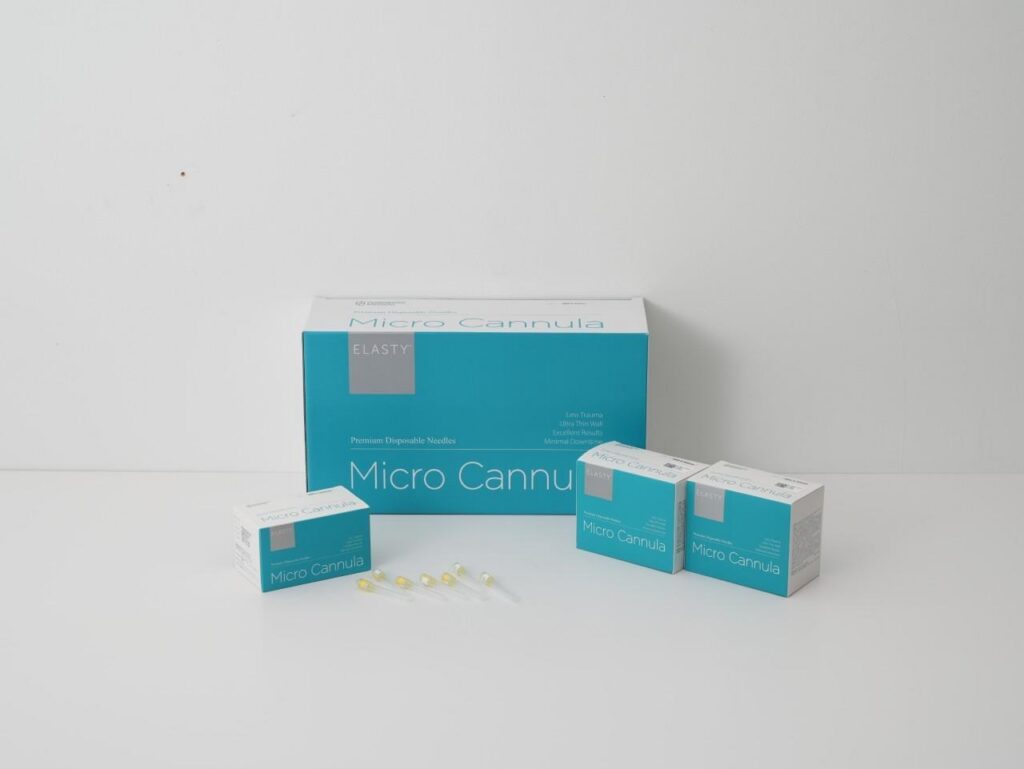
A cannula may look simple, but small manufacturing differences can affect its performance.
Changes in lumen size, surface finish, bonding, shaft alignment, or port shape may alter how the device feels and how filler moves through it.
Automated Assembly and UV Bonding
ELASTY cannulas are produced using automated assembly systems designed to maintain consistent measurements and component alignment.
Premium UV adhesive bonding is used instead of conventional epoxy. A dual-stage UV curing process supports bond durability and hub stability.
This is important because the connection between the stainless steel shaft and hub must remain secure while pressure is applied through the syringe.
Inspection and Blockage Testing
ELASTY cannulas go through several quality checks, including:
- Vision-based dimensional inspection
- Structural inspection
- Air pressure blockage testing
- Complete visual inspection
- Material sourcing checks
- Product traceability controls
Manufacturing takes place under ISO Class 8 cleanroom conditions with controlled environmental procedures.
Individually Packaged Cannula and Needle
Each sterile blister contains one ELASTY Micro Cannula and one matching sharp piercing needle.
Individual packaging protects the sterile device before use and gives the provider the correct introducer needle for the selected cannula size.
Store each pack in a clean, dry area away from direct sunlight.
Frequently Asked Questions About Cannulas
1. What Does Cannula Gauge Mean?
Gauge refers to the external diameter of the cannula. A higher gauge number indicates a smaller diameter, while a lower gauge number indicates a larger diameter.
2. Which Cannula Gauge Is Best for Thick Filler?
A lower gauge cannula may provide a larger lumen and reduce flow resistance. The correct size still depends on the filler instructions, treatment area, injection plane, and provider technique.
3. How Do I Select Cannula Length?
Choose length according to the distance between the planned entry point and treatment area. Consider required reach, shaft control, anatomy, and the number of entry points needed.
4. Is a Blunt Cannula Safer Than a Needle?
A blunt cannula may reduce some punctures, bruising, and tissue trauma in selected procedures. It can still enter or damage blood vessels, so it does not remove the risk of vascular complications.
5. Does a Cannula Hurt Less Than a Needle?
A cannula may require fewer skin punctures, which may reduce discomfort for some patients. Patient sensitivity, entry point creation, treatment area, filler pressure, and injector technique also affect pain.
6. What Is the Advantage of an Ultra Thin Wall Cannula?
An ultra-thin wall cannula can provide a larger internal lumen relative to the outer size. This may support smoother injection of higher viscosity products with less resistance.
Choose a Cannula Based on the Procedure
Cannula selection should never come down to gauge alone.
Gauge affects external size, flow, flexibility, and shaft control. Length determines reach. Wall thickness changes the internal lumen. Tip design, surface finish, and hub construction affect insertion, product release, and handling.
The patient’s anatomy, filler type, treatment plane, and injector technique must bring those specifications together.
ELASTY Micro Cannulas give U.S. aesthetic professionals a broad selection of blunt tip cannula sizes backed by precision manufacturing, medical-grade stainless steel, sterile single-use packaging, and detailed quality checks.
Contact DongBang Medical USA to review available ELASTY gauge and length options for your practice.