
A smooth thread, a spiral thread, and a barbed thread may share the same material, but their designs differ. If you compare them by name alone, you can miss details that matter during product selection and patient consultation.
Face threading starts with understanding the design, checking the specifications, and matching those details to the patient’s needs. This guide explains the main PDO thread types and uses MIRACU products from DBM Aesthetics as practical examples. Here, face threading means aesthetic thread procedures, not facial hair removal.
What You’ll Learn
- How mono, screw, and barbed PDO threads differ.
- What thread sizes and instrument gauges tell you.
- How patient assessment shapes product selection.
- What to check in safety information and FDA documents.
What Is Face Threading? Understanding PDO Threads
Start by separating three things: the material, the thread design, and the device’s intended use.
What Is Polydioxanone?
Polydioxanone, or PDO, is a synthetic material used in absorbable medical sutures. Manufacturers form it into different configurations, including smooth, spiral, and barbed threads. Other absorbable thread materials include poly-L-lactic acid, or PLLA, and polycaprolactone, or PCL.
The material name doesn’t establish what a finished device can do. When you review a PDO thread, check its construction, specifications, and labeling together.
How Absorption and Collagen Response Differ
PDO threads gradually degrade, but strength loss and complete absorption follow different timelines. Neither automatically tells you how long a cosmetic result will last.
Animal research has documented tissue changes around implanted PDO threads. That supports studying their potential to stimulate collagen production, but it doesn’t prove predictable skin rejuvenation in every patient. Separate biological mechanisms from demonstrated human outcomes.
Mono PDO Threads: Understanding Smooth Designs
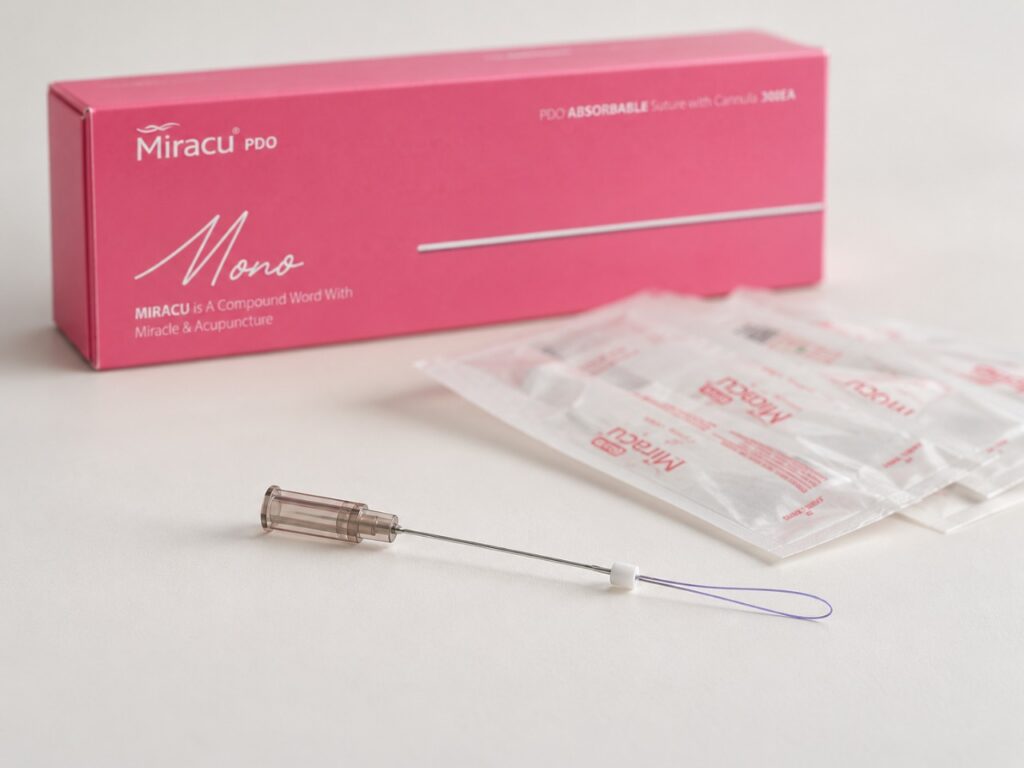
Smooth threads provide a useful starting point because they lack the projections found on barbed designs.
What Defines a Mono Thread?
A mono thread typically consists of one smooth filament without barbs. Its surface doesn’t provide the same mechanical engagement as a cog thread.
Providers discuss smooth threads in relation to fine lines, skin texture, and tissue response. You still need evidence relevant to the device and proposed use before describing expected improvements in skin quality.
MIRACU Mono as an Example
DBM lists MIRACU Mono as a smooth, non-barbed PDO monofilament suture. Listed options include 27G × 40 mm and 29G × 50 mm, showing that one product category can contain several instrument sizes and lengths.
Those dimensions don’t tell you everything. Check the suture diameter, actual thread length, delivery instrument, and current instructions for use. Don’t assume that a finer instrument means a particular clinical result.
Screw PDO Threads: Understanding Spiral Configurations
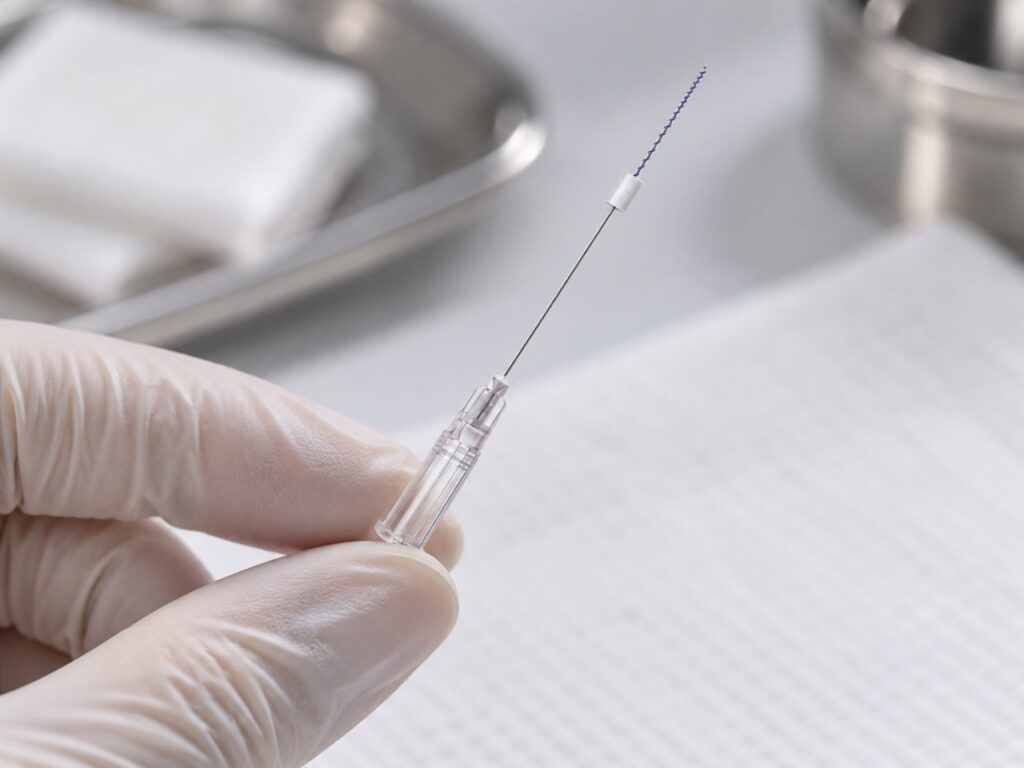
Screw threads change the filament’s arrangement, so look beyond the material itself.
How Screw Threads Differ From Mono Threads
Screw designs commonly feature a filament wound around the delivery instrument. Some configurations use one filament, while others use multiple filaments.
Names such as “double screw” and “tornado” can differ between manufacturers. Ask for a technical description rather than assuming that similar names mean identical construction.
MIRACU Mono Screw Within This Category
DBM includes Mono Screw in its MIRACU portfolio. When you review this product, confirm the filament arrangement, USP suture size, thread length, and delivery instrument against current documentation.
What Spiral Construction Does Not Establish
A spiral shape alone doesn’t prove better collagen production or longer results. Screw threads also don’t replace dermal fillers simply because a product description discusses contour improvement. Explain the specific evidence and limitations during consultation.
Barbed PDO Threads: Cog Patterns and Construction

Barbed threads add tissue engagement, but the details of that engagement vary between devices.
How Cog Threads Engage Tissue
“Cog” commonly refers to a barbed thread. Unidirectional designs have barbs pointing in one direction. Bidirectional designs include opposing directions, while other configurations distribute projections around the filament.
These differences affect mechanical behavior. They do not, by themselves, establish an appropriate facial application or predictable cosmetic outcome.
Cut, Molded, and Press Sculpted Designs
Manufacturers may cut projections into a filament or form them through molding or press sculpting. Review barb geometry, tensile strength, and holding performance under defined testing conditions.
A construction method does not prove better clinical outcomes. Laboratory performance and patient outcomes answer different questions.
MIRACU Barbed Thread Examples
Forte Basic has bidirectional cogs and a heatless press sculpting process. Its Forte Fix description references multidirectional blocking technology. Elasty Line includes a listed coating and bidirectional cog design. Use these descriptions to compare construction, then request supporting technical data.
Comparing PDO Thread Types and Specifications
Use the design category to organize your review, then check the dimensions of the exact device.
| PDO thread type | Basic structure | Barbs | Main distinction | Specifications to review | MIRACU examples |
|---|---|---|---|---|---|
| Mono | Smooth filament | No | Lacks barb-based engagement | Suture diameter, thread length, instrument | Mono |
| Screw | Spiral configuration | Typically no | Changes the filament arrangement | Filament count, diameter, length | Mono Screw |
| Barbed | Filament with projections | Yes | Engages tissue through barbs | Barb pattern, strength, diameter, instrument | Forte Basic, Forte Fix, Elasty Line |
Instrument Gauge Is Not Thread Thickness
Needle or cannula gauge describes the delivery instrument. USP sizing describes the suture diameter. Within the zero-based USP series, more zeros generally indicate a finer suture.
Thread length and instrument length also differ. Two products with the same instrument gauge may contain different sutures, so compare each specification separately.
Reading the LSCO Listing
DBM lists LSCO with a 19G × 45 mm option. That listing gives you an instrument specification, but it doesn’t fully define the thread’s construction. Request the technical sheet before comparing filament diameter, barb geometry, or thread length.
Patient Assessment Before PDO Thread Treatment

A product comparison only becomes useful after you understand the patient’s concern.
Identify What the Patient Wants to Change
Start with the patient’s concern, then examine tissue thickness, facial movement, asymmetry, and previous treatments. A patient concerned about facial contour may need a different discussion from someone focused on skin texture.
A cosmetic concern alone doesn’t establish suitability for thread procedures. Discuss other treatments or specialist assessment when they better address the patient’s needs.
Review Medical History
Check allergies, infection, bleeding history, medications, healing problems, and device-specific contraindications. Consider previous surgery, fillers, and permanent implants.
Do not tell patients to stop prescribed anticoagulants without coordinating with their prescribing clinician. A cosmetic treatment plan should not disrupt necessary medical care.
Set a Realistic Treatment Plan
A small study involving 31 PDO thread procedures reported favorable outcomes. However, those findings don’t establish suitability for every patient or product. Discuss alternatives, limitations, and uncertainty rather than promising a specific result.
Safety, Consent, and Recovery After Thread Procedures

Your responsibility includes preparation, clear consent, and access to follow-up care.
Prepare and Document
Use appropriate aseptic technique and sterile single-use devices. Check package integrity and expiration dates. Record the device model, lot number, treatment details, and baseline photographs.
If your plan includes local anesthetic, assess relevant risks and document its use. Maintain the skills and referral arrangements needed to evaluate complications.
Explain Downtime and Possible Complications
Patients may bruise or experience swelling and tenderness. Complications can include dimpling, asymmetry, visible or palpable threads, extrusion, infection, and nerve injury. A published clinical report documents dimpling and extrusion after facial thread procedures.
Give Clear Aftercare Instructions
Explain recovery expectations, alternatives, and potential complications before treatment. Provide written instructions and a follow-up plan.
Worsening pain, spreading redness, drainage, fever, or an exposed thread needs prompt clinical assessment. New facial weakness or sensory changes also require assessment. Tell patients not to pull, trim, or reposition threads themselves.
Reviewing MIRACU Labeling and FDA Documentation
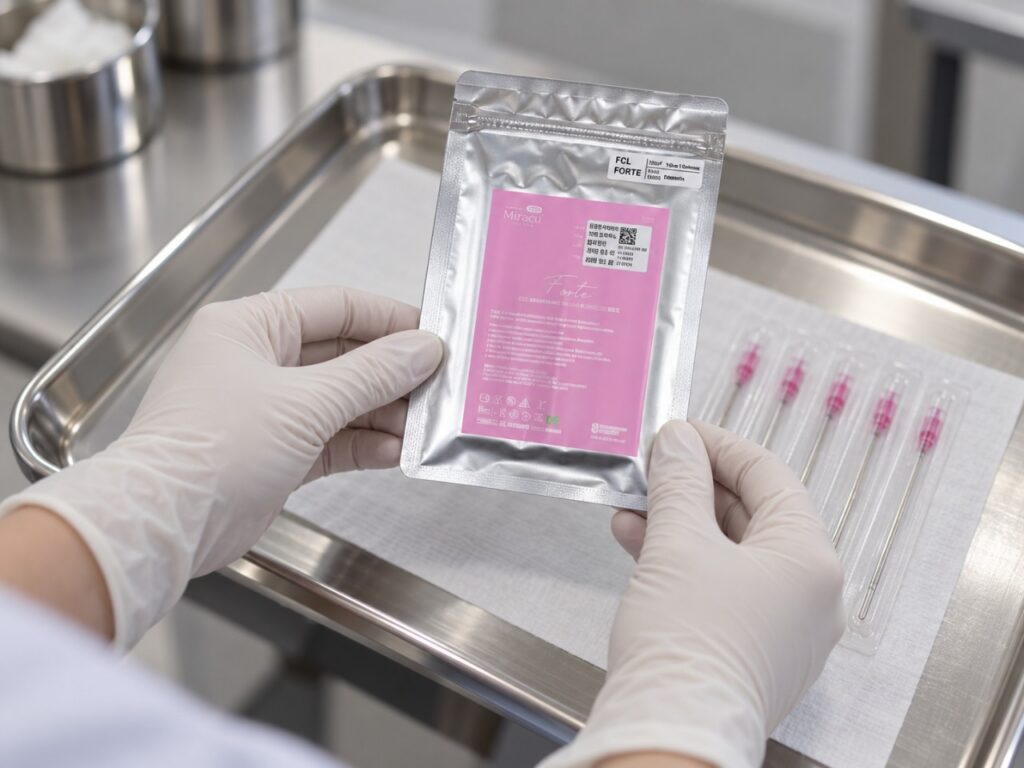
Technical descriptions explain the product. Regulatory documents clarify its cleared indications.
Verify the Exact Device
Match the model you purchase with its current labeling and applicable FDA record. FDA clearance, approval, establishment registration, and device listing describe different processes.
The cited MIRACU barbed clearance, K172602, and mono clearance, K251414, are cleared for soft tissue approximation in dermatological applications. The IFU states the sutures are not intended for lifting and supporting tissues or for interior body cavity applications. Review the complete documents rather than treating clearance as authorization for every cosmetic application.
Understand DBM’s Distribution Role
DBM Aesthetics serves as Dongbang Medical’s U.S. subsidiary and distribution platform. Request current specifications, storage requirements, labeling, and available training information. Quality certifications do not replace device-specific regulatory review.
Frequently Asked Questions About Face Threading
These answers address common questions about design, duration, and intended use.
1. How Do Mono, Screw, and Barbed PDO Threads Differ?
Mono threads use smooth filaments. Screw threads use spiral configurations. Barbed threads have projections that engage tissue.
2. Are Cog Threads and Barbed Threads the Same?
“Cog” commonly means barbed. Check the manufacturer’s documentation for the exact pattern.
3. How Long Do PDO Threads Last?
Review product-specific absorption and strength data. The time until threads dissolve does not automatically predict cosmetic result duration.
4. Do PDO Threads Stimulate Collagen?
Research describes a foreign body response around implanted PDO, including collagen capsule formation around the filament. Collagen stimulation is a biological process that occurs, not a cleared indication or a promised result.
5. Does FDA Clearance Cover Every Cosmetic Application?
No. Review the exact device’s cleared indications, exclusions, and current labeling before considering its use.
6. Are All MIRACU Threads Interchangeable?
No. Compare each model’s construction, dimensions, delivery instrument, and labeling.
Choose Through Assessment and Documentation
PDO identifies the material, not the complete device. Smooth, spiral, and barbed designs require separate review.
MIRACU products provide examples of these differences. Use current technical documents to understand each model.
Combine that information with patient assessment, appropriate training, and honest consent. Clear expectations matter as much as product selection.
Contact DBM Aesthetics for product specifications and ordering assistance, or shop MIRACU products on our website to explore available options.
For use by appropriately licensed and trained medical professionals.